Learn how to think in cubic feet like the pros do
Planning a move is hard enough without playing a guessing game. You know what you own, but how do you figure out how much space it will actually take in a moving truck? That is where understanding volume, specifically in cubic feet, can make or break your moving plan.
In this guide, we will walk you through how to estimate the volume of your move with confidence. You will learn how to use a moving volume calculator, what items take up the most space, and how to think in cubic feet so you do not overpay for a truck that is too large or end up squeezing your dresser next to your dog in the backseat.
Let’s break it down step by step.
What Is Cubic Feet and Why Does It Matter?
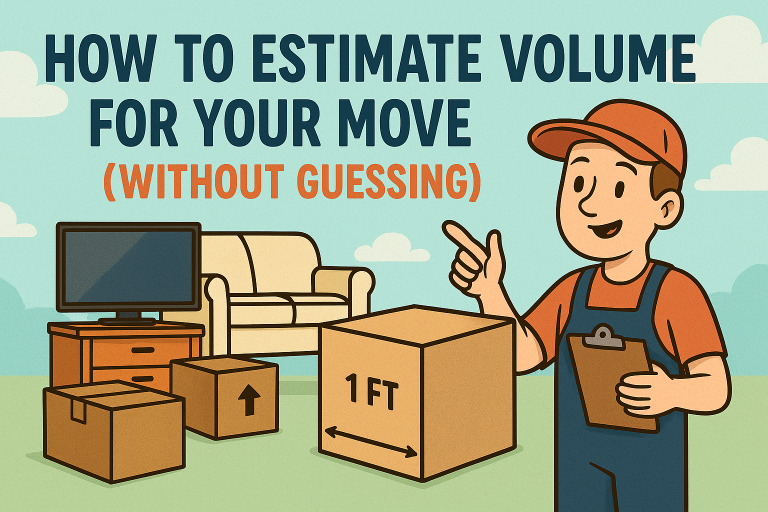
Moving trucks are measured in feet, specifically cubic feet, which is a measurement of volume. A cubic foot is the space taken up by a box that is one foot tall, one foot wide, and one foot deep.
Think of it this way: if you had a box that is 3 feet long, 2 feet wide, and 2 feet tall, you would multiply the dimensions together:
3 × 2 × 2 = 12 cubic feet.
Why does this matter for moving? Because every truck size—whether it is a cargo van, 10-foot truck, or 26-foot box truck—is designed to hold a certain number of cubic feet of household goods.
Knowing how many cubic feet your items take up will help you:
-
Pick the right truck size
-
Avoid paying for unused space
-
Prevent last-minute extra trips
Average Volume by Home Size (Quick Reference)
Here’s a rough idea of how many cubic feet each type of home typically needs:
-
Studio apartment: 200–400 cubic feet
-
1-bedroom apartment: 400–600 cubic feet
-
2-bedroom home: 800–1,200 cubic feet
-
3-bedroom home: 1,200–1,600+ cubic feet
-
4-bedroom+ home: 1,800+ cubic feet
These numbers include standard furniture, some boxes, and household appliances. However, you may need more or less depending on how much you actually own.
Step 1: Break It Down by Room
Rather than trying to estimate everything at once, break your move into rooms and categories. Go one room at a time and make a list of large furniture and boxes.
Here is a quick breakdown of how many cubic feet common items take up:
Living Room
-
Sofa (3-seat): 45–60 cu ft
-
Recliner: 25–30 cu ft
-
Coffee table: 10–15 cu ft
-
Entertainment center: 20–40 cu ft
-
Large TV (60”+): 10–15 cu ft
Bedroom
-
Queen bed (with mattress): 55–65 cu ft
-
Nightstand: 5–10 cu ft
-
Dresser (6-drawer): 30–45 cu ft
-
Small desk: 15–25 cu ft
Kitchen
-
Dining table (4-person): 20–30 cu ft
-
Chairs (4): 10–12 cu ft total
-
Refrigerator: 45–60 cu ft
-
Boxes of kitchen goods: 3–5 cu ft each
Other
-
Washer/Dryer: 40–60 cu ft combined
-
Book boxes: 1.5–2.5 cu ft each
-
Storage bins: 4–6 cu ft each
-
Large dog crate: 10–15 cu ft
As you go through your home, jot down each item and its approximate volume. You can then total everything to get a solid estimate.
Step 2: Use a Moving Volume Calculator
If the math above is making your head spin, try using a moving volume calculator. These tools ask for the number of items in each room and calculate an estimated total in cubic feet.
A good calculator should allow you to select:
-
Furniture pieces by room
-
Box sizes (small, medium, large)
-
Appliances
-
Special items (like bikes, grills, or safes)
Once you add your items, the calculator gives you a total volume in cubic feet, which you can use to find the right truck size.
You can try the free estimator on our site at MovingTruckSize.com to make this even easier.
Step 3: Account for Awkward Shapes and Air Gaps
Packing is not perfect. Just because your items technically add up to 800 cubic feet does not mean they will pack tightly into 800 cubic feet of truck space.
You need to leave room for:
-
Padding and moving blankets
-
Awkwardly shaped items
-
Air gaps between stacked boxes
-
Space to prevent damage
A good rule of thumb: Add 10 to 15 percent extra space to your total to account for packing inefficiencies.
So if your calculated move is 1,000 cubic feet, you should plan for a truck that holds at least 1,100 to 1,150 cubic feet.
Step 4: Match Your Volume to a Truck Size
Now that you know how many cubic feet you need, you can match it to a truck size. Here is a quick chart:
| Truck Size | Approx. Cubic Feet | Typical Use |
|---|---|---|
| Cargo van | 200–250 cu ft | Studio or small apartment |
| 10-ft truck | 400–450 cu ft | Studio or 1-bedroom |
| 15-ft truck | 650–700 cu ft | 1–2 bedroom |
| 20-ft truck | 1,000–1,200 cu ft | 2–3 bedroom |
| 26-ft truck | 1,600–1,800+ cu ft | 3–5 bedroom |
Remember to compare this with your adjusted volume that includes extra space for packing.
Step 5: Factor in Boxes (They Add Up Fast)
Boxes are the sneaky space-takers in any move. One or two boxes? No big deal. Twenty boxes? You are talking serious volume.
Here is a quick reference:
-
Small boxes (1.5 cu ft): Books, tools, canned goods
-
Medium boxes (3.0 cu ft): Kitchenware, small appliances
-
Large boxes (4.5–5.0 cu ft): Bedding, clothing, toys
-
Wardrobe boxes (10 cu ft): Hanging clothes
If you are moving a full household, expect 30 to 100+ boxes depending on your lifestyle. A minimalist might use 25. A family of four might have over 80.
Multiply your average box volume by the number of boxes you expect to bring to get a realistic estimate.
Step 6: Don’t Forget the Garage, Basement, or Shed
Many people forget to factor in spaces like the garage or storage shed, which often hold bulky and awkward items like:
-
Lawn mowers (15–25 cu ft)
-
Bicycles (10–15 cu ft each)
-
Tool benches (20–30 cu ft)
-
Boxes of holiday decorations (5–15 cu ft per box)
Add these to your total before finalizing your estimate.
Final Tips for Estimating Moving Volume
-
Always round up
If you are between two truck sizes, choose the larger one. Running out of room mid-move is a nightmare. -
Estimate by cubic feet, not truck length
A 15-foot truck from one company may hold more volume than a 15-foot truck from another. -
Take photos
Walk through your rooms and take photos to help when filling out a calculator later. -
Use stacking efficiently
Stack boxes to the ceiling of the truck whenever possible, and use soft items (pillows, clothes) to fill air gaps.
Recap: How to Estimate Moving Volume (Without Guessing)
-
Learn how to think in cubic feet, not just the number of rooms
-
Break down your home by room and item
-
Use a moving volume calculator to total it all up
-
Add 10 to 15 percent to account for air gaps and awkward shapes
-
Choose a truck that meets or slightly exceeds your total cubic footage
Ready to Estimate Your Move?
Try our free Moving Volume Calculator to find out exactly how many cubic feet you need and get matched with the right size truck—fast, free, and without the guesswork.