Planning a move from a 3-bedroom house comes with a lot of questions. One of the biggest? Choosing the right size moving truck. If the truck is too small, you may end up making multiple trips or leaving items behind. Too large, and you are paying for empty space you do not need.
This guide will walk you through everything you need to know about selecting the right moving truck for a 3-bedroom house. Whether you are hiring movers or doing it yourself, this moving guide is packed with practical information based on how moving companies actually estimate truck size.
We will cover typical truck sizes, what they can hold, and how to make sure you do not underestimate your space needs. Let’s get into it.
How Much Space Does a 3-Bedroom House Require?
A typical 3-bedroom home ranges from 1,200 to 1,600 square feet. On average, this kind of home will require 1,200 to 1,500 cubic feet of loading space. That number can vary depending on how fully furnished the house is, whether you have garage items, and how efficiently things are packed.
A well-furnished 3-bedroom house with appliances, a garage full of tools, and multiple TVs will need more space than a sparsely furnished rental with only the basics.
To move efficiently, your goal should be to fit everything in one trip. This saves time, fuel, and unnecessary stress. For most moves of this size, you will be looking at a 26-foot moving truck.
Best Moving Truck Size for a 3-Bedroom House
For most 3-bedroom homes, a 26-foot truck is the standard recommendation. Here is why:
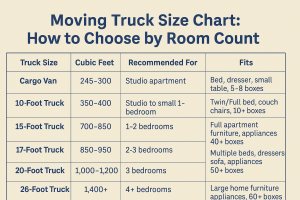
26-Foot Moving Truck (1,400–1,700 cubic feet)
-
Typically holds: 3 to 5 bedrooms
-
Fits 10,000 to 12,000 pounds of belongings
-
Often includes a loading ramp and tie-down rails
-
Ideal for long-distance or one-trip moves
-
May also accommodate items from a garage, shed, or small attic
This size offers the capacity to move large furniture items like:
-
Three full-size mattresses or beds
-
Couches and sectionals
-
Multiple dressers, nightstands, and wardrobes
-
Full dining set with chairs
-
Washer, dryer, and refrigerator
-
Multiple TVs (up to 65 inches)
-
Tools, yard equipment, and kids’ outdoor toys
If you have a fully furnished 3-bedroom house and want to avoid multiple trips, the 26-foot truck is the safest bet.
Other Truck Sizes: Could You Go Smaller?
There is a common question when people are trying to cut costs: “Can I move a 3-bedroom house with a 20-foot truck?”
Here is a breakdown of why that may not work:
20-Foot Moving Truck (1,000–1,200 cubic feet)
-
Typically holds: 2 bedrooms
-
Can feel tight for 3 bedrooms with full furniture sets
-
May require multiple trips or overflow into a second vehicle
-
Not ideal for cross-country moves
Unless your 3-bedroom home is very lightly furnished, a 20-foot truck is likely too small. Even with creative packing, it will be difficult to fit large beds, dressers, couches, appliances, and boxes into one load.
22-Foot Truck (1,200–1,400 cubic feet)
This size is sometimes available through independent truck rental companies. It is larger than the 20-footer but still might come up short if you have large furniture or bulky extras like outdoor gear.
Use this option only if your home is on the smaller side of a 3-bedroom range and you are confident you can pack efficiently.
What About a Trailer or Cargo Van?
For a move of this size, trailers and cargo vans are not suitable. They are intended for smaller moves, such as single-bedroom apartments or studio units.
Using a trailer or cargo van for a 3-bedroom move would require too many trips, too much fuel, and too much physical strain. Even with multiple helpers, this type of equipment is not efficient for full-home moves.
Factors That Affect the Size You Need
Not all 3-bedroom homes are created equal. Here are a few things that can push you toward a larger truck:
1. Furniture Style
If you have bulky, oversized furniture such as sectionals, king-size beds, hutches, or armoires, they will take up significantly more space than modular or flat-pack pieces.
2. Garage and Outdoor Equipment
A lawn mower, bicycles, ladders, tools, patio furniture, and seasonal décor can add several hundred pounds and many cubic feet to your move.
3. Packed Closets and Storage
Some homes have attics, sheds, or storage units that are not accounted for in the basic room count. Holiday items, old files, or sports gear may need more space than expected.
4. Appliances
If you are taking a washer, dryer, refrigerator, or upright freezer with you, they will take up valuable floor space in your truck.
5. Kids’ Rooms
If your children have bunk beds, play tables, bookshelves, or large toys, that adds to the total load volume.
How to Estimate Space More Precisely
If you want a more precise estimate, use a moving truck size calculator. This tool lets you plug in how many large items you have—like beds, desks, sofas, and TVs—and gives you a cubic foot total and truck recommendation.
You can also use an average moving estimate of 150 to 200 cubic feet per fully furnished room. For a 3-bedroom house with living room, kitchen, and dining room included, this gives you:
-
3 bedrooms: 600 cubic feet
-
Living room: 250 cubic feet
-
Kitchen/dining: 250 cubic feet
-
Miscellaneous/storage: 300+ cubic feet
Total estimate: 1,400 to 1,600 cubic feet
This lines up with what a 26-foot truck provides.
Moving Tips for a 3-Bedroom Home
Even the right truck size will not help if your packing is inefficient. Here are some tips to make the most of your space:
1. Break Down Furniture
Remove table legs, disassemble bed frames, and take apart shelves to make stacking easier.
2. Use Uniform Boxes
Standard-sized moving boxes are easier to stack tightly and make use of vertical space.
3. Load Largest Items First
Place couches, mattresses, and appliances toward the front of the truck to anchor the load.
4. Fill Gaps with Boxes and Soft Items
Place pillows, blankets, and small boxes in between furniture to avoid shifting during transport.
5. Label Strategically
Group boxes by room and label them clearly to make unloading faster and more organized.
Hiring Movers vs. Renting Your Own Truck
If you are hiring a full-service mover, they will bring the right truck based on your in-home estimate. If you are going the DIY route, truck rental companies like U-Haul, Budget, and Penske offer similar size trucks with slightly different capacities and pricing.
Always compare truck size, mileage allowance, and loading equipment. Some companies offer a liftgate instead of a ramp, which is a major help if you have heavy furniture or appliances.
Should You Consider Two Trucks?
If a 26-foot truck is not available or you want to stagger your move, you might consider two smaller trucks. For example, two 16-foot trucks can technically hold similar space, but this is only ideal for local moves. For long-distance relocations, it adds complexity, cost, and fuel usage.
You are almost always better off with one large truck instead of juggling two.
Summary: Your Best Option
For most families moving from a 3-bedroom home, a 26-foot moving truck is the most reliable choice. It offers the space, structure, and weight capacity needed to move all your belongings in a single trip.
Here is a quick reference:
| Truck Size | Best For | Cubic Feet | Bedrooms Covered |
|---|---|---|---|
| 20-Foot Truck | Lightly furnished 2–3 bedroom homes | 1,000–1,200 | 2–3 (tight fit) |
| 22-Foot Truck | Small 3-bedroom homes | 1,200–1,400 | 3 (minimal storage) |
| 26-Foot Truck | Full 3-bedroom homes | 1,400–1,700 | 3–5 bedrooms |
Try the Moving Truck Size Estimator
Still unsure? Use our free Moving Truck Size Estimator to get a custom recommendation based on the number of rooms and furniture items. It is a quick, accurate way to eliminate the guesswork and avoid last-minute surprises.